
Kaomojis Copy and Paste ✿
The ultimate collection of cute Japanese text emoticons. Browse hundreds of designs — click to copy instantly, filter by category, and build custom text combinations using the builder bar!
Advertisement
Happy & Excitement
(20)Hearts & Cute
(20)Shy & Blushing
(20)Animals & Pets
(20)Showing 4 of 9 categories
What are Kaomojis?
Kaomojis (顔文字) are Japanese text-based emoticons created by combining characters, punctuation marks, and special symbols. The word comes from "kao" (顔, meaning face) and "moji" (文字, meaning character). Unlike Western emoticons like :-) which must be read sideways, Kaomojis are read horizontally and offer a much wider range of expressions, from simple smiles to animal paws and action details.
Originating in the early days of personal computer messaging and forums in Japan, they evolved using double-byte characters, Katakana symbols, and mathematical glyphs. Today, they are popular globally for bringing aesthetic charm to social media bios, nicknames, and text messages.
History of Kaomojis
The origin of Kaomojis dates back to 1986 in Japan, when Yasushi Takahara, a member of the early Japanese online network ASCII NET, used the emoticon (^_^) to convey a happy face. This marked a major departure from Western emoticons like Scott Fahlman's :-) (introduced in 1982), which required users to tilt their heads sideways to read them. Takahara's horizontal design was much more intuitive and immediately captured the Japanese digital community's imagination.
Throughout the late 1990s and early 2000s, Kaomojis exploded in popularity and complexity with the rise of Japan's massive 2channel (now 5channel) bulletin board system. Users of these forums expanded the basic character set, incorporating Cyrillic, Greek, and Katakana symbols to represent blushing cheeks, sweat drops, cat ears, and actions like table flipping (e.g. (╯°□°)╯︵ ┻━┻). This culture transformed Kaomojis from simple representations of faces into a vibrant form of horizontal digital art that is used worldwide today.
Popular Kaomoji Categories & Meanings
Japanese text faces are extremely expressive. Here are some of the most popular styles you can copy and use:
Happy & Smiling 🥰
Express cheerfulness, laughter, or pure joy. These often use high eyes, wavy smiles, or closed curved lines to signify smiling cheeks.
Example: (❁´◡`❁) or (●'◡'●)
Love & Cute Hearts 💖
Perfect for showing affection, sending kisses, or flirting. These incorporate heart characters, blowing kiss icons, and blushing cheeks.
Example: (。♥‿♥。) or (づ ̄ ³ ̄)づ
Shy & Blushing 😳
Used to express embarrassment, modesty, or shyness. These kaomojis feature line strokes representing blushing cheeks, or hands covering the eyes.
Example: (〃▽〃) or (*ノωノ)
Animals & Pets 🐾
Adorable representations of animals like bears, cats, puppies, and bunnies. They use brackets for ears, whiskers, and paws.
Example: ʕ•́ᴥ•̀ʔっ or (=^・^=)
How to Make Your Own Text Faces
Creating a custom kaomoji involves combining three distinct structural components:
1. The Body/Border: Parentheses or brackets that outline the head, e.g. ( ) or [ ].
2. The Eyes: Punctuation marks or symbols representing the eyes, e.g. • •, ^ ^, or ಠ ಠ.
3. The Mouth/Nose: A middle symbol representing expressions, e.g. _ (flat), ω (cute kitty mouth), or 益 (angry growl).
You can then embellish your characters with hands (e.g. っ, o) or sparkles (✧, *) to denote actions!
Where Can You Use These Emoticons?
Because Kaomojis are plain Unicode characters and not image files, they work anywhere standard text input is accepted. This includes:
➤ Social Media: Instagram bios, TikTok captions, Pinterest boards, and YouTube comments.
➤ Messaging Apps: Discord, Telegram, WhatsApp, and iMessage.
➤ Gaming Profiles: Nicknames in Minecraft, Roblox, Animal Crossing, and Steam.
Tips on Using Kaomojis Effectively ✿
When incorporating Kaomojis into your daily communication, keep these best practices in mind:
1. Don't crowd the line: Kaomojis rely on punctuation and symbols, so inserting too many in a single line might make your message look cluttered and hard to read. Use them selectively at the end of a thought or as a reaction.
2. Watch out for spacing bugs: Some systems might render full-width Japanese spacing differently. Our curated picker is optimized with normal spaces to ensure clean rendering on all viewports.
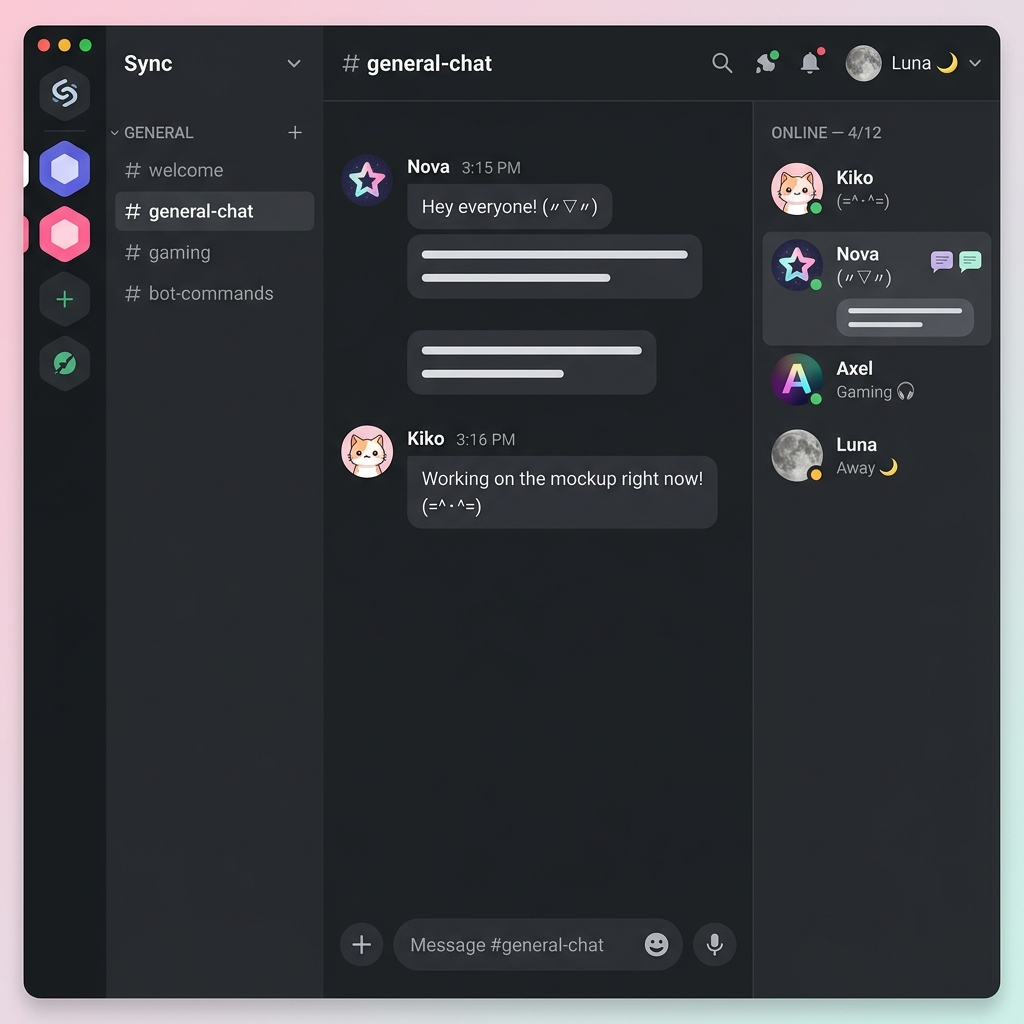
3. Use them for profile statuses: Small blushing emoticons or sleepy kaomojis make perfect Discord custom status messages that show your current mood without using heavy words.
Western Emoticons vs. Japanese Kaomojis
Text-based emoticons developed differently in the West compared to Japan. Here is a quick breakdown of the core differences:
| Feature | Western Emoticons (e.g. :-)) | Japanese Kaomojis (e.g. (•‿•)) |
|---|---|---|
| Reading Angle | Sideways (must tilt your head to read) | Horizontal (read straight, naturally) |
| Primary Focus | Focuses on the mouth (e.g. :) vs :() | Focuses on the eyes (e.g. (*_*) vs (T_T)) |
| Character Set | Basic ASCII characters only | Wide Unicode symbols, Katakana, and Cyrillic |
| Expressiveness | Limited to basic facial representations | Highly detailed, including arms, sparkles, and actions |
Also Explore Our Other Tools
Want to enhance your styled text faces with unique letters, numbers, or symbols? Check out our other typography tools:
➤ Social Fonts Generators: Design custom layouts for bios, captions, and posts on Instagram, Facebook, Twitter (X), YouTube, LinkedIn, WhatsApp, and Discord.
➤ Gaming Name Styles: Create unique, styled nicknames and copy custom symbols for Free Fire and PUBG Mobile.
➤ Main Font Changer: Access over 250+ unique styles (including script, bubble, and bold fonts) on the FontGenix Homepage.
➤ Nepali Font Style Generator: Convert Nepali script text into 180+ stylish calligraphy styles on our Nepali Font Style Generator.
➤ Cute Font Generator: Generate sweet, starry, and floral styled text on our Cute & Pretty Font Generator.
➤ Emoji Copy & Paste: Copy and paste 3,600+ standard colorful emoticons on our Emoji Picker page.
➤ Text Symbols Copy & Paste: Browse and copy 2,000+ special characters (hearts, stars, mathematical, and arrows) from our Text Symbols library.
Frequently Asked Questions
A Kaomoji (from Japanese "kao" meaning face, and "moji" meaning character) is a popular Japanese style of emoticon created using standard keyboard punctuation marks, symbols, and double-byte characters. They are read horizontally and express characters, animals, and complex emotions without requiring graphic image files.
Simply click on any Kaomoji box to copy it directly to your system clipboard. You can also click the Clipboard/Folder icon to accumulate multiple Kaomojis and texts in the Clipboard Builder at the top of the page, then copy them all at once.
Yes! Kaomojis are composed entirely of standard Unicode symbols, meaning they are fully compatible with social media bios, comments, server names, and gaming nicknames. Just copy and paste them directly into Instagram, TikTok, Discord, Roblox, Steam, and more.
If a Kaomoji displays empty boxes or question marks, it means your device's operating system doesn't have the font files installed to render specific special characters (like Japanese Katakana or mathematical symbols). Updating your device or web browser usually resolves this issue.